


 Create Account
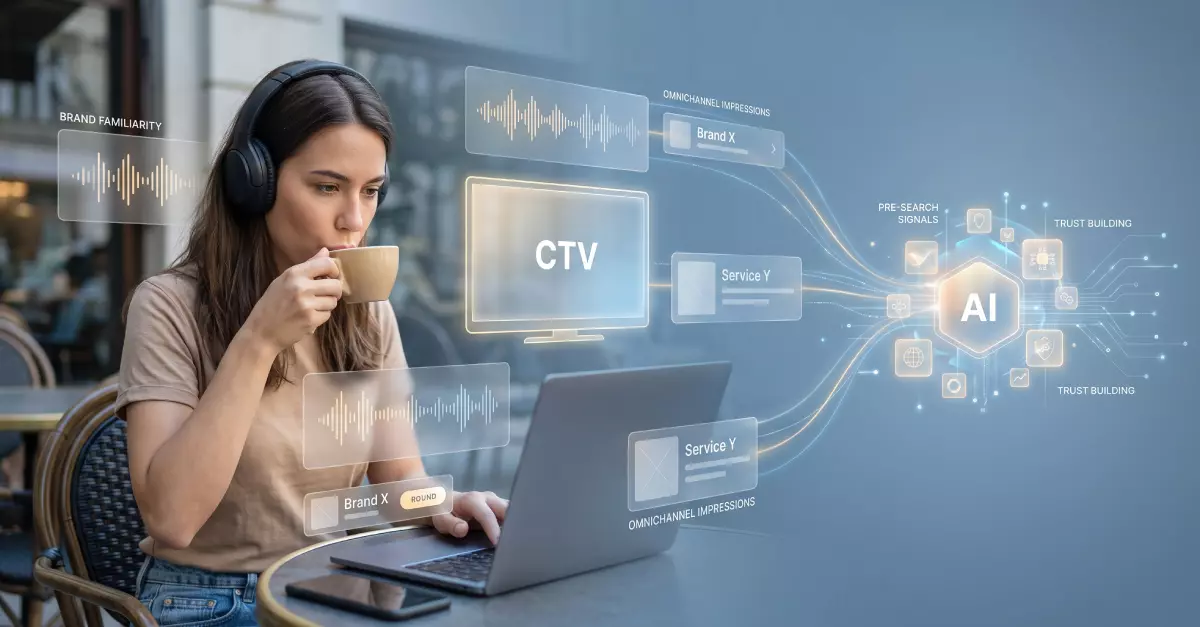
Paid search has carried digital advertising for decades. It’s the first channel most advertisers learn, and for a long time, it was the safest bet in the budget. That’s changing fast, and AI is the reason why.
AI-generated answers are pulling users away from traditional search results. Advertisers now have to plan for a customer journey that might never include a click at all. This week, we’re looking at what that shift means and what you can do to stay visible when the click disappears.
What Zero-Click Search Means for Advertisers
Search ads aren’t dead, but the conditions that made them reliable are wearing thin.
- Cost per click (CPC) keeps climbing across most industries, squeezing returns for advertisers who depend on it
- Intent signals are harder to read as behavior spreads across more devices and platforms
- Tools like Google’s AI Overviews, ChatGPT, and Perplexity now serve synthesized answers, so a user’s question can get answered without a single click
- The old path of “search > click > browse > convert” is getting compressed or skipped entirely
- A bottom-of-funnel, click-to-convert strategy assumes a journey fewer people are actually taking
If you only show up at the click, you’re missing the earlier stages where people decide what they even want. Display and retargeting alone don’t do much for an audience that may never click through in the first place.

Think about how you actually shop for something big, like a car or a piece of furniture. You don’t wake up one day and search “buy sofa now.” You spend weeks noticing brands, scrolling past ads, half-listening to a podcast spot. By the time you finally search for something specific, you’ve usually already decided who’s in the running. That pre-search decision making is exactly where advertisers need to compete now.
The Role of Frequency and Brand Familiarity
There’s a well-documented psychological principle called the “mere exposure effect”. People develop a preference for things simply because they’ve seen them before, even without actively engaging. That matters more than ever in a zero-click world.
Here’s why frequency carries so much weight right now:
- Consumers pick brands they recognize when they hit a decision point, even if they can’t say why
- Frequency across channels builds trust over time in a way one well-placed search ad can’t
- Share of attention becomes the real currency when the click may never come
- Relevant, well-timed impressions build familiarity without feeling like a hard sell
This is the point where brand building and performance advertising stop being separate strategies and start working together.
How Programmatic Reaches Audiences Without the Click
Programmatic advertising doesn’t need a click to deliver value. It serves relevant impressions across display, streaming audio, connected TV (CTV), and over-the-top (OTT) video, and every one of those touches builds recall.
We run fully managed programmatic campaigns at Genius Monkey, and this is exactly where the model earns its keep. Repeated exposure across channels builds familiarity passively, reaching people during the awareness and consideration stages instead of waiting around for purchase intent to show up. Our team actively manages and adjusts these campaigns to find where your audience is actually spending their time. It’s not something you set once and walk away from. It takes continuous refinement to make every impression count.

That distinction matters more than people realize. A lot of self-serve platforms hand you a dashboard and leave you to figure out targeting, pacing, and creative rotation on your own. A managed approach means someone’s actually watching the campaign daily, adjusting bids and placements as performance data comes in, not just at the end of the month when it’s too late to fix anything.
Following Your Audience Across Every Device and Channel
People bounce between phones, tablets, laptops, and TVs all day long, and their journey rarely follows a straight line. A platform that isn’t tied to one device or channel is the only way to keep up with that.
Genius Monkey’s meta-DSP and OmniMonkey system pull inventory from multiple demand-side platforms (DSPs) under one roof. That gives you reach across a lot of ground:
- Consistent messaging whether someone’s streaming a show, scrolling social, listening to a podcast, or reading the news
- Repeated impressions that actually turn into brand recognition, because the message stays consistent everywhere it shows up
- Coverage that a single-channel programmatic approach, let alone search alone, simply can’t match
We work with clients in healthcare, legal, financial services, and plenty of other industries where the buyer’s path tends to be rather complicated. A patient researching a procedure might see a display ad on their laptop at work, hear an audio spot on their commute, then watch a CTV ad on their couch that evening. None of those touchpoints alone drove the decision. Together, they built the trust that made the decision easier.

Optimizing Your Content for AI Search
Getting cited inside an AI-generated answer is quickly becoming as important as ranking on page one. Some people call it generative engine optimization (GEO), others call it answer engine optimization (AEO). Either way, the goal is the same.
AI tools pull from content that’s clearly structured and written to answer a specific question directly. Here’s what that looks like in practice:
- Add schema markup so search engines understand exactly what your content covers
- Write answer-first, putting the core point in the first sentence instead of burying it three paragraphs down
- Structure your headings to match how people actually phrase their questions
- Keep answers concise and self-contained, since AI tools favor passages that make sense without extra context
Pairing this kind of content with programmatic advertising gives you a two-sided approach. You show up inside the AI answer, and you stay visible everywhere else your audience goes.
Measuring Success Without Relying on Clicks
A lot of advertisers still default to last-click attribution, which hands all the credit to the final touchpoint and ignores everything that built the relationship before it. That model was already flawed, but its weaknesses are even more apparent now. In a world edging closer to zero-click, it’s going to consistently undercount the value of your programmatic impressions.

We track campaigns at the impression level, which means the ads that moved someone toward a conversion actually get credit for doing so. Our dashboard is built for this kind of visibility, and it lets you zero in on the signals that matter in a low-click environment:
- View-through conversions, meaning conversions that followed an impression even without a click
- Brand lift, or measurable increases in awareness and favorability
- Search volume trends, since a rise in branded searches after a campaign runs tells you something worked
- Marketing efficiency ratio (MER), which looks at revenue against total ad spend instead of isolating one channel
- Customer intent signals that show where someone actually sits in the buying journey
Changing how you measure success matters just as much as changing where your budget goes.
Preparing for the Future
None of this has fully arrived yet, but it’s close enough that waiting to see what happens isn’t a good strategy. Advertisers who prepare now will be the ones still standing out when the shift finishes playing out. Staying visible during the awareness phase is what’s going to matter most, and that’s the real takeaway here. It’s about showing up throughout the whole journey, not just at the very end of it.
Content built for AI search matters, but it works best paired with a platform built to get your message in front of people wherever they go. We’ve been running these campaigns since 2011, and our team knows how to help you convert more and waste less.
If you’re ready to get ahead of the zero-click shift, reach out to Genius Monkey and let’s talk about what your campaign should look like next.