



Last updated: October 2026
The biggest shopping holidays of the year in the U.S. are the winter holidays, back-to-school, Mother’s Day, Valentine’s Day, Father’s Day, and Easter. The winter season is in a class of its own, with $1.013 trillion in retail sales forecast for November and December 2026 (NRF, 2026). Black Friday draws the most shoppers of Thanksgiving weekend, and Cyber Monday is the biggest online sales day of the year.
This calendar covers every date that matters for 2026 and 2027, what each one is worth, and when to put media in front of the people shopping it. The short version for anyone running campaigns: the money moves on the holiday, but the decision often gets made weeks earlier.


The brands that win Black Friday usually started winning it in October. That’s when budgets start getting spent, prices start getting compared, and shoppers start forming a short list.
Key Takeaways
- The winter holidays are the biggest shopping event in the U.S. by a wide margin. Back-to-school is second, and Mother’s Day leads the spring holidays.
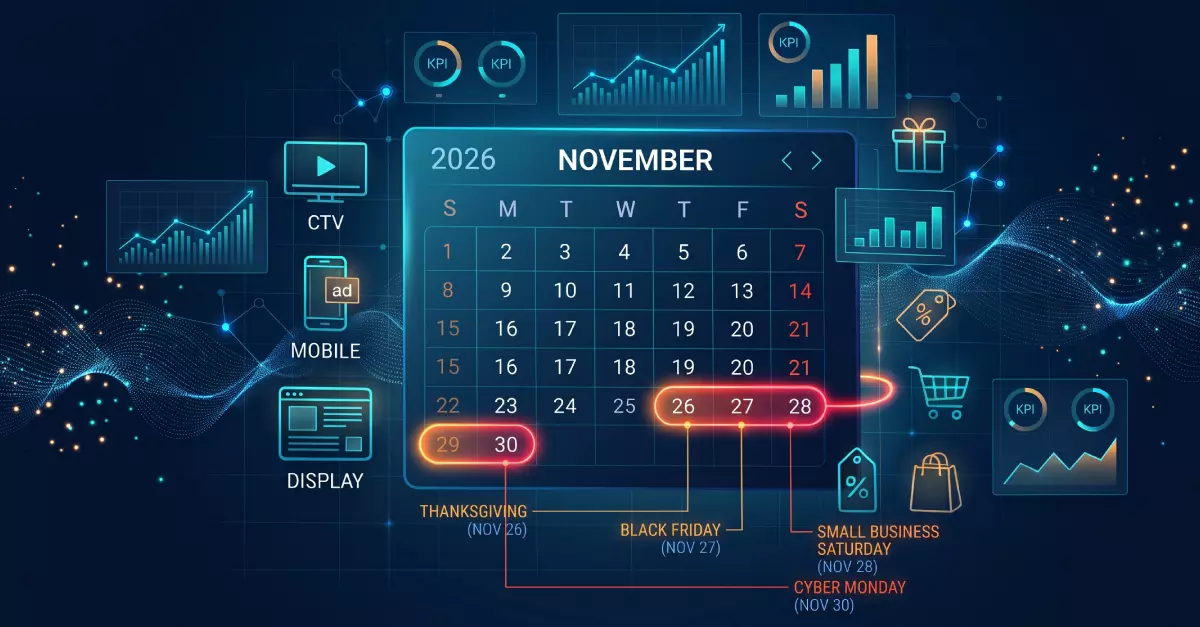
- Thanksgiving falls on Nov. 26 in 2026, so Black Friday is Nov. 27, Small Business Saturday is Nov. 28, Cyber Monday is Nov. 30, and Giving Tuesday is Dec. 1.
- Holiday shopping starts before November for a large share of buyers. Start prospecting in October and build toward Cyber Week instead of switching on for Black Friday.
- Use CTV and video for reach while families watch together, audio for travel days, display and retargeting to close, and keep spending after Christmas, when gift cards get used.
What Are the Biggest Shopping Holidays of the Year?
The biggest shopping holidays of the year, ranked by total U.S. consumer spending, are the winter holidays, back-to-school, Mother’s Day, Valentine’s Day, Father’s Day, Easter, the Super Bowl, Halloween, and St. Patrick’s Day. Most figures below come from the surveys NRF and Prosper Insights & Analytics run before each major holiday.
| Holiday | Latest U.S. spending | Source |
|---|---|---|
| $1.013 trillion forecast for 2026 | NRF, 2026 |
| $146.8 billion in 2026 ($43.3B K-12 plus $103.5B college) | NRF, 2026 |
| $38 billion in 2026, a record | NRF, 2026 |
| $29.1 billion in 2026, a record | NRF, 2026 |
| $27.9 billion in 2026, a record | NRF, 2026 |
| $24.9 billion in 2026, a record | NRF, 2026 |
| $20.2 billion in 2026, a record | NRF, 2026 |
| $13.5 billion forecast for 2026 | NRF, 2026 |
| $7.7 billion in 2026, a record | NRF, 2026 |
Two big events don’t fit neatly in that ranking. Amazon’s Prime Day is an online sales event, not a holiday, and U.S. retailers drove $26.4 billion in online spending during the June 23 to 26, 2026 event (Adobe, 2026). The Fourth of July has no NRF spending total, but 87% of consumers planned to celebrate in 2026 and expected to spend a record average of $94.41 on food (NRF, 2026).
The winter season dwarfs everything else. November and December have averaged about 19% of total annual retail sales over the past five years (NRF). NRF counts core retail only, leaving out auto dealers, gas stations, and restaurants (NRF, 2026).
What Is the 2026 Holiday Shopping Calendar?
The 2026 holiday shopping calendar runs from Halloween on Oct. 31 through New Year’s Eve on Dec. 31, with the peak packed into the five days from Thanksgiving on Nov. 26 to Cyber Monday on Nov. 30. Election Day on Nov. 3 also shapes the media market this year.
| Date (2026) | Holiday or event | Advertiser note |
|---|---|---|
| Sat., Oct. 31 | Halloween | Last big spend before the winter season. Prospecting for gift shoppers should already be live. |
| Tue., Nov. 3 | Election Day (midterms) | Political ads crowd video and CTV inventory through October. That demand ends with the vote. |
| Wed., Nov. 11 | Veterans Day | Federal holiday on a Wednesday. A good window to test offers before Thanksgiving week. |
| Thu., Nov. 26 | Thanksgiving | NFL tripleheader and the Macy’s parade. The centerpiece of November TV viewing. |
| Fri., Nov. 27 | Black Friday | The weekend’s top shopping day, in stores and online. Heaviest frequency of the season. |
| Sat., Nov. 28 | Small Business Saturday | Local and regional brands lean in. Tighten geo footprints around your stores. |
| Mon., Nov. 30 | Cyber Monday | The biggest online sales day of the year. Retargeting and mobile carry the day. |
| Tue., Dec. 1 | Giving Tuesday | Donation day that closes Cyber Week. Cause tie-ins fit here. |
| Fri., Dec. 4 to Sat., Dec. 12 | Hanukkah | Eight nights of gifting, starting the Friday after Cyber Week. |
| Mon., Dec. 14 | Green Monday | Mid-December sales push as shipping deadlines approach. |
| Sat., Dec. 19 | Super Saturday | Last Saturday before Christmas. In-store and local delivery messaging. |
| Fri., Dec. 25 | Christmas Day | Three NFL games. Streaming hit 54% of TV last Christmas, and mobile drove most online sales. |
| Dec. 26 to Jan. 1 | Kwanzaa and gift-card week | Returns, exchanges, and gift-card spending. Keep campaigns running. |
| Thu., Dec. 31 | New Year’s Eve | Last day of the season and the start of January resolution shopping. |
Green Monday falls on the second Monday of December, a name eBay gave the day in 2007 (eBay). Dates for every row are verified against OPM, CalendarLabs, Hebcal, GivingTuesday, and American Express, listed in the Sources below.
When Does Holiday Shopping Start?
Holiday shopping starts before November for a large share of U.S. shoppers. In NRF’s 2025 survey, 42% of shoppers planned to begin browsing and buying before November (NRF, 2025), and NRF says at least two in five have reported starting before November for more than a decade (NRF).
The early start keeps getting earlier. Deloitte’s 2026 survey found that 22% of shoppers plan to start sooner than last year, 28% of their budgets are likely to be spent by the end of October, the highest share in six years, and 4 in 10 plan to shop October sales events (Deloitte, 2026). Adobe expects $95.8 billion in online spending in October 2026 alone, up 8% year over year (Adobe, 2026).

That changes the job of holiday media. If your first holiday impression lands on Black Friday, you’re introducing yourself to people who already made a short list. Prospecting in October puts your brand on that list. The November spend then converts the demand you built.
What Happens From Thanksgiving to Cyber Monday?
The five days from Thanksgiving through Cyber Monday are the peak of the U.S. shopping year. A record 202.9 million consumers shopped over that stretch in 2025 (NRF, 2025). Adobe expects Cyber Week to drive $47.5 billion online in 2026, 17.3% of the full season’s online spending in five days (Adobe, 2026).
Thanksgiving, Thursday, Nov. 26
Thanksgiving is a shopping day and a TV day. Adobe expects $6.9 billion in online spending on Thanksgiving 2026 (Adobe, 2026). The NFL’s tripleheader runs on CBS, FOX, and NBC, after Netflix streams the first-ever Thanksgiving Eve game on Nov. 25 (NFL, 2026).
Last year’s Chiefs-Cowboys game averaged 57.2 million viewers (NFL, 2025), the Macy’s parade drew 34.3 million across NBC and Peacock (NBCUniversal, 2025), and people watched 103.4 billion minutes of TV on Thanksgiving Day (Nielsen, 2025).
Black Friday, Friday, Nov. 27
Black Friday was again the top shopping day of Thanksgiving weekend in 2025, both in stores and online (NRF, 2025). Adobe forecasts $12.9 billion in online sales for Black Friday 2026, the second-biggest online day of the season (Adobe, 2026). Prime Video streams the NFL’s Black Friday game, Denver at Pittsburgh (NFL, 2026).
Small Business Saturday, Saturday, Nov. 28
American Express estimates Small Business Saturday drove $18 billion in consumer-reported spending at small businesses in 2025 (American Express, 2025). For regional and local brands, it’s the day to concentrate spend around store footprints.
Cyber Monday, Monday, Nov. 30
Cyber Monday is the biggest online shopping day of the year. Shoppers spent $14.25 billion online on Cyber Monday 2025, up 7.1% (Adobe, 2026), and Adobe expects $15.1 billion in 2026 (Adobe, 2026).
Giving Tuesday, Tuesday, Dec. 1
Americans gave $4.0 billion on GivingTuesday 2025, up 13% from 2024 (GivingTuesday, 2025). For brands with a cause, it’s a natural close to the week.
What Are the Biggest Shopping Days in December?
The biggest shopping days in December are Green Monday on Dec. 14, Super Saturday on Dec. 19, and the week after Christmas, when returns, exchanges, and gift-card spending pick up. Hanukkah runs from sundown on Friday, Dec. 4 to nightfall on Saturday, Dec. 12 (Hebcal).
Green Monday and Super Saturday
Green Monday is the mid-December push for shoppers who still want delivery before Christmas. NRF expected a record 158.9 million consumers to shop on Super Saturday, the last Saturday before Christmas, in 2025 (NRF, 2025). As shipping cutoffs pass, messaging should move from “order now” to in-store pickup, local delivery, and gift cards.
Christmas Day, Friday, Dec. 25
Christmas Day is a streaming day. On Christmas 2025, streaming reached 54% of daily TV usage, and December 2025 set a record with streaming at 47.5% of all TV viewing (Nielsen, 2026). In 2026, Netflix streams two NFL games on Christmas Day and FOX carries a third at night (NFL, 2026). Mobile drove 66.5% of online sales on Christmas Day 2025, the highest share of the season (Adobe, 2026).
Post-Holiday Returns and Gift-Card Week


The week after Christmas is a second shopping season. In NRF’s 2025 Super Saturday survey, 70% of consumers planned to shop the week after Dec. 25, mostly for sales and promotions (45%) and to use gift cards (26%) (NRF, 2025). Gift cards topped the list of gifts people wanted, at 50% (NRF, 2025).
Returns pick up at the same time. Retailers expected 17% of holiday sales to be returned in 2025 (NRF, 2025), and 1 in 7 of the season’s online returns happened from Dec. 26 to Dec. 31 (Adobe, 2026).


Going dark on Dec. 26 hands your newest buyers to whoever keeps showing up. Keep retargeting live through New Year’s and into January, when new buyers decide whether to come back. We cover that stretch in what to do after the holiday advertising rush.
What Are the Biggest Shopping Holidays Outside the Winter Season?
The biggest shopping holidays outside the winter season are back-to-school, Mother’s Day, Valentine’s Day, Father’s Day, and Easter, each worth more than $24 billion in 2026. Here’s the 2027 calendar.
| Date (2027) | Holiday or event | Advertiser note |
|---|---|---|
| Sun., Feb. 14 | Super Bowl LXI and Valentine’s Day | Both on the same day. Watch-party food and gifts compete for one Sunday. |
| Wed., Mar. 17 | St. Patrick’s Day | Bars, restaurants, and beverage brands. Short, local, and social. |
| Sun., Mar. 28 | Easter | Family, candy, and meals. Start two to three weeks out. |
| Sun., May 9 | Mother’s Day | The biggest spring holiday. Flowers, jewelry, and experiences. |
| Mon., May 31 | Memorial Day | Long weekend that opens the summer sales season. |
| Sun., June 20 | Father’s Day | Gifts, outings, and gear. Record spending in 2026. |
| Summer, date not yet announced | Prime Day | Ran June 23 to 26 in 2026. Expect deal competition across retail. |
| Sun., July 4 | Independence Day | Food, travel, and fireworks. Observed Mon., July 5. |
| July to September | Back-to-school and college | The second-biggest season. Shoppers start early. |
| Mon., Sept. 6 | Labor Day | End-of-summer sales and the last back-to-school push. |
| Sun., Oct. 31 | Halloween | Costumes, candy, and decor, and the start of holiday prospecting. |
Super Bowl LXI is set for Feb. 14, 2027 at SoFi Stadium (NFL, 2026).
- Back-to-school. K-12 families expect to spend a record $43.3 billion and college students and families a record $103.5 billion in 2026, the first time college topped $100 billion (NRF, 2026).
- Mother’s Day. A record $38 billion in 2026, up from $34.1 billion in 2025 (NRF, 2026). It now outspends Valentine’s Day by about $9 billion.
- Super Bowl. A record 213.1 million adults planned to watch in 2026 and spend $20.2 billion on the day (NRF, 2026). Super Bowl LX drew 125.6 million viewers (Nielsen, 2026). In 2027 it lands on Valentine’s Day.
- Father’s Day. A record $27.9 billion in 2026, a 16% jump from $24 billion in 2025 (NRF, 2026).
When Should You Start Buying Holiday Media?
Start buying holiday media in October, at least four to six weeks before your biggest sales day, and plan it in September. Campaigns need time to find the audiences and creative that convert before the most expensive days arrive.
Your own buying cycle should set the start date. Ashley Furniture’s Rex Debord has said that more than 40% of their customers take 90 days before they convert (read the case study). For a brand like that, a Black Friday sale has to start earning attention in late summer. Genius Monkey’s Conversion Cycle report shows how long your buyers actually take to decide, so budget and pacing match reality.
2026 adds a wrinkle. Midterm spending is projected to reach a record $11.6 billion this cycle (AdImpact, 2026). October alone has historically carried 28% to 36% of political ad spend in a cycle, and connected TV is projected at 23% of 2026 political spending (AdImpact, 2026). Book CTV and video early, and expect political demand to fall away after the Nov. 3 vote.
Already into November? Start now. December, gift-card week, and January still reward a late start, and a campaign that starts small and scales on what’s working beats one that waits. Our holiday budget strategies for winter and beyond cover how to keep that momentum into the new year.
How Should You Pace Holiday Budget and Frequency?
Pace holiday budget in four stages: build reach in October and early November, peak from Thanksgiving through Cyber Monday, sustain through Super Saturday, and keep a share live for gift-card week and January. Frequency should rise as the purchase gets closer and fall back once the moment passes.
- Build (October to mid-November). Prospect wide on CTV, video, audio, and display at moderate frequency, and let early results show which audiences and creative respond.
- Peak (Nov. 26 to Dec. 1). Put the most budget into Cyber Week. Raise frequency on warm audiences and retarget everyone who visited during the build.
- Sustain (Dec. 2 to Dec. 24). Hold steady through Green Monday and Super Saturday. Shift messaging to shipping deadlines, in-store pickup, and gift cards.
- Retain (Dec. 26 to January). Retarget new buyers, gift-card holders, and anyone who made a return. This is where holiday buyers become repeat buyers.
Cap frequency at the household level on CTV so a family watching three football games together doesn’t see the same spot every break. And refresh creative for each stage, because a Black Friday offer is stale by Green Monday.


Your budget should follow your buyers, not the calendar. Genius Monkey runs every buy through a single layer over 30+ DSPs that bid against each other for the same impressions, and budget is rebalanced daily. Winners gain budget. Losers get cut. When prices and performance change by the day, that beats any plan written in September.
Which Channels Work Best for Holiday Advertising?
The channels that work best for holiday advertising are CTV and streaming video for reach while families watch together, online video for gift research, audio for travel days, display and native for always-on reach, and retargeting to close the sale. The strongest plans run them together and measure them on one timeline.
| Channel | Best holiday moment | Why it works |
|---|---|---|
| CTV and OTT | Thanksgiving, Christmas, NFL weekends | Streaming hit a record 47.5% of TV viewing in December 2025 |
| Online video | October and November research | Gift research, demos, and reviews before the purchase |
| Audio | Travel days and holiday weekends | Nearly half of Americans stream online audio while driving |
| Display and native | The whole season | Low-cost reach and deal messaging on every device |
| Retargeting | Cyber Monday and gift-card week | About 70% of online carts are abandoned before checkout |
| DOOH | Small Business Saturday and Super Saturday | Screens near stores, malls, and transit at shopping time |
CTV. Streaming took 46.7% of TV in November 2025 (Nielsen, 2025) and a record 47.5% in December (Nielsen, 2026). The IAB projects CTV ad spend to grow 13.8% in 2026, with social and CTV leading growth across all digital channels (IAB, 2026). Programmatic OTT and CTV puts your brand on the biggest screen in the house. For live sports, Genius Monkey’s In-Play CTV puts your brand on screen during the play itself instead of waiting for a commercial break.
Video and display. Programmatic video carries the story while people research, and display and native keep the offer on every screen. Native suits gift guides and deal roundups, as our native vs display comparison explains.
Audio. Holidays mean road trips. In the Infinite Dial 2026, 81% of Americans 12 and up had listened to online audio in the last month (Edison Research, 2026), and nearly half stream online audio while driving (Edison Research, 2026). See our guide to programmatic audio advertising.
Retargeting and mobile. The average online cart abandonment rate is 70.22%, based on 50 studies (Baymard Institute). Mobile drove 56.4% of online holiday transactions in 2025 (Adobe, 2026). Cross-device retargeting brings them back when the next discount drops.
Most retail sales still happen offline. E-commerce was 16.6% of total U.S. retail sales in the fourth quarter of 2025 (U.S. Census Bureau, 2026). Measurement has to follow the whole path to the sale. Pixel Monkey, the attribution behind Genius Monkey, puts display, video, CTV, audio, and DOOH on one timeline and credits every channel that contributed instead of only the last click. Our guides to marketing attribution and media mix modeling cover the rest.

A shopper who sees your ad on the TV on Thanksgiving and buys on a phone on Cyber Monday is one buyer, not two. If your reporting can’t connect those moments, it will credit the phone and starve the TV.
The Bottom Line
The winter holidays are the biggest shopping event of the year, and 2026’s calendar is tight, with Thanksgiving on Nov. 26 and Cyber Week ending Dec. 1. Start prospecting in October, peak through Cyber Week, keep spending through gift-card week, and measure every channel on the same timeline. The same playbook works for back-to-school, Mother’s Day, and every peak in between.
Bring us a budget and a goal. We’ll show you the path to conversion. Request a demo to see how Genius Monkey plans, buys, and measures holiday campaigns across every channel.
Sources
- National Retail Federation. NRF Forecasts 2026 Holiday Sales Growth as Consumers Remain Resilient. October 15, 2026.
- National Retail Federation. Winter Holiday FAQs.
- National Retail Federation. Consumers to Spend Second-Highest Amount on Record, According to NRF Holiday Survey. October 16, 2025.
- National Retail Federation. Thanksgiving Holiday Weekend Draws a Record 203 Million Shoppers. December 2, 2025.
- National Retail Federation. A Record 159 Million Consumers Expected to Shop on Super Saturday. December 15, 2025.
- National Retail Federation. Consumers Expected to Return Nearly $850 Billion in Merchandise in 2025. October 15, 2025.
- National Retail Federation. Majority of Back-to-School Shoppers Get a Head Start on the Season. July 14, 2026.
- National Retail Federation. Mother’s Day Spending Expected to Hit Record $38 Billion. April 21, 2026.
- National Retail Federation. Valentine’s Day Spending Expected to Reach New Records. January 27, 2026.
- National Retail Federation. Father’s Day Spending to Hit Record $27.9 Billion. June 10, 2026.
- National Retail Federation. Easter Spending Expected to Reach a Record $24.9 Billion. March 24, 2026.
- National Retail Federation. Super Bowl, 2026 Super Bowl Spending Survey.
- National Retail Federation. NRF Halloween Survey Shows Consumer Spending Expected to Reach $13.5 Billion. September 22, 2026.
- National Retail Federation. Consumers Leaning Into St. Patrick’s Day in 2026 as Holiday Spending Climbs. March 10, 2026.
- National Retail Federation. Independence Day.
- Adobe. U.S. Holiday Shopping Season to Hit Record $275.1 Billion Online, Rising 6.7% YoY. September 28, 2026.
- Adobe. Holiday Shopping Season Drove a Record $257.8 Billion Online with Consumers Embracing Generative AI Tools. January 7, 2026.
- Adobe. Summer Is the New Holiday Season: Prime Day Drives a Record $26.4 Billion. June 29, 2026.
- Amazon. Amazon Announces Prime Day Event From June 23-26. June 2, 2026.
- Deloitte. 2026 Deloitte Holiday Retail Survey. October 2026.
- Deloitte via PR Newswire. Deloitte: Holiday Spending Set to Increase 4% While Shoppers Focus on Value. October 15, 2026.
- American Express. Shop Small.
- American Express. On Small Business Saturday, American Express Reaches Goal to Drive $100 Billion in Consumer-Reported Spending at Small Businesses. December 2025.
- GivingTuesday. Generosity Sweeps the Globe: Participation and Donations Rise on Another Record-Breaking GivingTuesday. December 3, 2025.
- U.S. Office of Personnel Management. Federal Holidays.
- Legal Information Institute, Cornell Law School. 2 U.S. Code 7, Time of election.
- CalendarLabs. 2026 USA Holidays and 2027 USA Holidays.
- Hebcal. Chanukah 2026.
- eBay. eBay Launches Green Monday Deals, Our Biggest December Deals Day of the Year. December 10, 2018.
- NFL Communications. 2026 NFL Schedule Announced. May 14, 2026.
- NFL. 2026 NFL Schedule Release: Packers-Bears, Bills-Broncos, Rams-Seahawks in Christmas Tripleheader. May 15, 2026.
- NFL. 2025 Thanksgiving Day NFL Games Shatter Viewership Records. December 2025.
- NBCUniversal. NBC’s Macy’s Thanksgiving Day Parade Set All-Time Viewership Record. December 1, 2025.
- Nielsen. Broadcast and Streaming Serve Up a Historic Month of TV in Nielsen’s The Gauge. December 16, 2025.
- Nielsen. Streaming Shatters Multiple Records in December 2025 with 47.5% of TV Viewing. January 20, 2026.
- Nielsen. Super Bowl LX Final Viewership Rises to 125.6 Million Viewers with Verified Big Data. February 19, 2026.
- IAB. 2026 Outlook Study. January 2026.
- AdImpact. AdImpact Reveals 2026 Election Cycle to Reach Record $11.6 Billion in Ad Spending. June 11, 2026.
- AdImpact. Updated Political Projection Report, 2025-2026. June 2026.
- Edison Research and SSRS. The Infinite Dial 2026 and presentation. March 12, 2026.
- Baymard Institute. Cart Abandonment Rate Statistics. Updated September 22, 2025.
- U.S. Census Bureau. Quarterly Retail E-Commerce Sales, 4th Quarter 2025. March 10, 2026.
- Genius Monkey. Ashley Furniture expanded their customer base and increased in-store conversions nationwide with Genius Monkey. Case study.
- Genius Monkey. About Genius Monkey.


